So today was my first time helping out at our schools annual fete. Lots of things going on, lots of stalls staffed by volunteers - all selling donated goods/services to raise money for the school. I participated - helping out at the icecream stall... which predictably was very busy with all the kids around. It got me thinking though - on the one hand it felt good to contribute to the school, but helping out at the stall, and doing some of the pack down work afterwads, but in terms of the social networking that was acheived how does it stack up (not that this was the purpose of the fete mind you) against time invested online, in virtual social networks? virtual communities... how effective is that kind of activity in creating the social bonds so very important to us - how much of the interaction, with the selective memories most of us possess will be remembered? How co-hesive a group was formed from the day and what did most people take away from it. My experience while I was with the kids, was that I was somewhat isolated, because they have specific needs, and want to do things that I wouldn't necessarily want - things that sometimes stop meaning social connection. Perhaps the organising committee was able to establish much better working relationships - but for those on the periphery who were helping people who were primary organisers of a stall etc - what of our connection to the group... not everyone can be in that inner group - is my effort worth less social connection then the primary organiser?
That being said would the addition of online communication between the people/parents involved including those at the periphery have necessarily improved social connections - or would be just better informed? How does the knowing of status/progress/events enhance our social connection with a group? is it the same as being there?
enough questions for now
Saturday, October 27, 2007
school fete

Thursday, October 25, 2007
social information network - info revolution
I love this video for so many reasons - but most of all it highlights the power of us!
Monday, October 22, 2007
Twine
Another interesting aspect to the participatory web has been rise of social networking - born of bulletin boards, forums, list-servers, wiki's and blogs - social networking has seen the growth of platforms that allow direct instant and delayed communications with friends and acquaintances - comparison of likes, sharing of music tasks, photos of the dog and latest camping trip and all the other fun things people fill their time with. The recent announcement of (see the O'Reilly Radar post here) Twine.com by Radar networks promises a platform that will allow social networks to develop information streams, that are correlated by an automated tagging system and most importantly by people... which is a very intriguing idea, since ideas come from people and who better then the source to best illuminate what is meant by that particular paragraph. It also relates by the recent Radar post about in-stream documents - documents are no longer a discrete file, to be opened/read/edited - the information they contain are objects that can be assembled based on search criteria into dynamic repositories of data. Can't wait to try it! Also interested to see how these platforms will play with efforts like Fedora
Sunday, October 21, 2007
Live Writer
I keep seeing references on the web to the windows new blogging tool - and since Ecto wants you to pay for that software I thought I might try it out... and so far I am impressed by the ease install and setup - it auto detected everything about my blogger site - guess the test will be to see how well it lets you embed things from other services etc
how about a Youtube video...
Thursday, October 18, 2007
data stacks
Peter Brantly over at O'Reilly Radar has another interesting post (The New Stacks) up this morning with respect to the changing face of libraries and the changing in their operating models - basically as brokers of licensed content - however and this is where it gets interesting, Peter states that we are in the middle of revolution...
"That is right. And by this, let us know that we do not refer to our physical, constructed caverns of electronics, racks, fiber, and cooling ducts, but rather, data that constitute within the clouds of our networks, and that permit us to reach out to embrace citizen science, new forms of expression, and foster new forms of creativity. Each encounter with our burgeoning network a new walk among the shelves, and a new fashion of browsing, no longer limited to what merely we see to the left, to the right; now also to further reaches of our imagination...."
This idea of new stacks for me continues the conversation about in-stream documents - libraries and the books they contain represent discrete bodies of information at the book and institution level, but as efforts like google book scanning and others become more mature, data will be freed from this physical and institutional bounds, available as packets across multiple reference points - building complex representations of ideas on the fly. Follow the link for the whole post.. lovely thinking
Monday, October 15, 2007
Documents In-Stream [SEC=UNCLASSIFIED]
Sent to you by presariov2000 via Google Reader:
By Peter Brantley
In ODF enters the Semantic Web, Rob Weir writes in his blog, An Antic Disposition, of the challenges of encoding the wide range of possible metadata describing a document in a semantically meaningful fashion within the constraints of a schema....
....The concept of a document as being a single storage of data that lives in a single place, entire, self-contained and complete is nearing an end. A document is a stream, a thread in space and time, connected to other documents, containing other documents, contained in other documents, in multiple layers of meaning and in multiple dimensions. What we call a traditional document is really just a snapshot in time and space, a projection into print-ready output form, of what documents will soon become......


Thursday, October 11, 2007
Google LatLong: Community maps in your search results
I love Google! Click through to see the new community maps you can now access as part of your search in google maps - so not only can you see the pizza places that are listed in the local directory/advertised, but now you can see the pizza places that people have mapped and made comment on. These are exactly the kind of tools that we should be using in our environmental work. Click through for the post on the google lat/lon blog.
Google LatLong: Community maps in your search results
Wednesday, October 10, 2007
“Wiki the Vote” on Congresspedia | Sunlight Foundation
Congresspedia has started a new wiki that will enable peer production of wiki entries for every political representative standing in the upcoming election - as Lawrence Lessig was saying in his recent appearance, the power of web2.0 will help us take back democracy among a whole range of other activities that it is currently enabling - peer production and greater public scrutiny of the political process and a greater transparency can only be good for democracy! Lets see if we can get done with money politics! See the story on the sunlight foundation page here “Wiki the Vote” on Congresspedia | Sunlight Foundation
another example of user generated data
There was a story on radio national today about climate change and how the migration patterns of birds are being affected by changes in the timing and severity of the seasons - part of the story was of particular interest to me because it talked about using data collected by citizens.
This is an example of data being collected by individuals for their own purposes being put to use for the greater good - providing the tools for people to capture and manage this data online will only increase access, awareness and benefits for all. This needs to be co-ordinated across themes and environments and its needs to be co-ordinated now!
So Dr Lynda Chambers from the Bureau of Meteorology Research Centre was delighted to discover two dairy farmers had kept records of the arrival and departure time of birds on their farm since 1973. The records of 20 species of water and land birds were taken at Middlesex in southwestern Australia.
Friday, October 5, 2007
participatory
This post by Mark Pesce http://blog.futurestreetconsulting.com/?p=39 was really cool for all the futurists out there, me included, the idea of a pervasive network linking the community outside of the realm of telco's etc was a very exciting idea - that and peer production and the power of the mob... Rheingold'esque
A real world example of this popped up in this interview with Lawrence Lessig...
Lawrence re-iterates the rising wave of peer production as a powerful force to capture the detail of money politics in this instance but I would argue of citizen participation in general. The tools of social networks and collaborative spaces like wiki's, blogs and forums, cell/mobile phones provide we the people the organising tools like never before. The ability to organize in physical and online spaces with thousands of like mind individuals across socio-economic and geographic boundaries.
Let the participation begin!
Tuesday, October 2, 2007
Rheingold EDUAUSEM2007
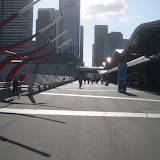
Photos from my recent trip to see Howard Rheingold talk at the educationau seminar... excellent trip - more later! - a shoutout to Laurel Papworth who was my table buddy and interpreter
 |
| Howard Rheingold eduausem20 |
